Author Julien Huang
Photo Julien Huang
Editor Julien Huang
In central Hualien, where the Philippine and Eurasian plates collide, the town of Yuli lives with frequent tremors and breathtaking mountain vistas as part of its everyday landscape. The renowned Batonguan Trail ( Indigenous name: Walami Trail), marking the eastern entrance to Yushan National Park—home to Taiwan’s highest peak—winds through this terrain. Originally carved by the Japanese to access Bunun tribal settlements, the path bears witness to a complex colonial history woven with both heroism and tragedy. Even the name “Yuli” itself reflects this heritage, derived from the Japanese transliteration of the indigenous place name.

More than a century after Japanese colonial rule ended, young Bunun people in Yuli have been carefully excavating their history, gradually reclaiming their identity. A new generation is now writing fresh chapters in the ongoing story of Bunun culture.

Pedaling Through Living History
Four returning young locals established “TANA culture,” each bringing unique skills to guide visitors through Yuli by electric bicycle, sharing tribal stories that no Google search could uncover. The naturally cheerful disposition of Taiwan’s indigenous peoples fills these tours with laughter and warmth.

At one stop, we pause before a massive ancient tree. Our guide Lo’oh explains: “During Japanese colonial rule, camphor trees were Taiwan’s crucial export resource, used to manufacture explosives and film stock. Over 80% of the world’s camphor came from Taiwan—as important then as TSMC is today!”

This land has played pivotal roles on the world stage for centuries. We should hold greater confidence in the ground beneath our feet, never underestimating its significance.

A Hunter’s Reservation-Only Kitchen
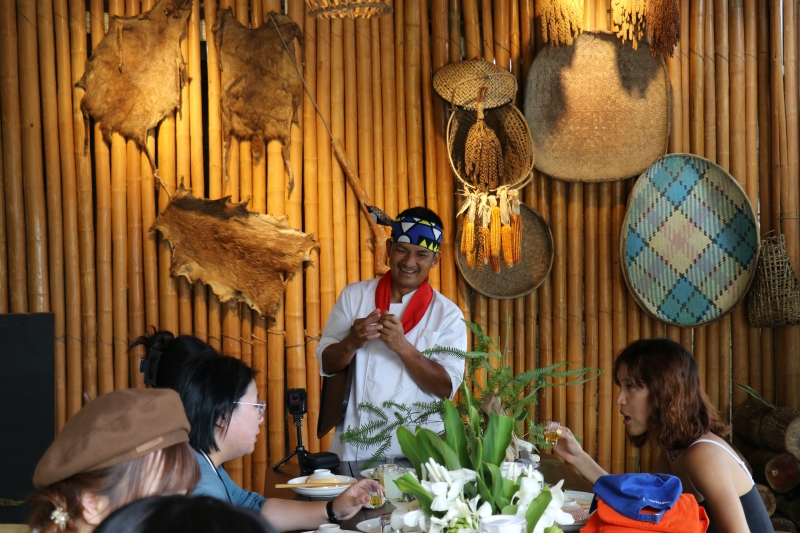
After roughly two hours of leisurely cycling, adjusted to our stamina, we arrived at a Bunun chef’s restaurant. The restaurant is called “嗡嗡私廚”, named after Chef Chou’s Bunun nickname “Weng Weng”. He stands waiting at the entrance, rifle in hand. He raises it skyward and fires. The gunshot splits the quiet mountain valley, jolting our urban senses awake. This is the Bunun hunter’s welcome ceremony—not merely greeting guests, but offering solemn respect to prey and nature alike.

Stepping inside, staff members approach bearing bamboo cups filled with richly aromatic millet wine. This is the welcome drink traditionally prepared for hunters returning from their labors. Through this cup, we too are accepted, becoming a small part of the tribe’s continuing narrative.
“Indigenous cuisine is best when kept simple,” Weng Weng remarks. Ingredients contain their own symphony of flavors; excessive seasoning only masks their true character. To eat well requires no detours—direct approaches work best. Yet in life, we must take some detours to appreciate what was perfect all along. This fundamental wisdom of the land lives on in indigenous daily practices.

To truly understand Bunun food culture, one must look beyond beans to another essential dimension: their meat-eating traditions. The Bunun people are renowned for their hunting prowess, with meat playing a central role in daily life. Weng Weng deftly handles various cuts with his knife. He describes himself as a “conservation hunter,” having spent seven years learning from tribal elders: when, where, and which animals eat which fruits—all knowledge gained through experience. “After hunting, we first make offerings at the door, dripping wine on the animal’s body to thank it for its life and bless its spirit,” he explains. The Bunun people use every part of the animal, wasting nothing.

Preserving Nature’s Bounty
This same attention to natural ethics drives “Huazi Natural Farming Food (花子好食)”, a brand specializing in additive-free handmade jams. Founder Ms. Wang previously worked in Taipei but returned home after the pandemic. Gazing at the orchards surrounding her family home, inspiration struck: transform these fruits into jam, extending their “lifespan.” She purchases surplus and overripe fruit from farmers—not only reducing food waste but hoping to establish fairer trading practices. When setting up stalls, she often turns her jams into cocktails, letting people taste different facets of Yuli’s terroir.


The journey becomes wrapped in stories; every destination gains meaning. Riding along, wind brushing our faces, everything feels purposeful—as if expressing the Bunun people’s wisdom of coexisting with the land. Coming to Yuli isn’t merely a trip; it’s an immersion in a philosophy of living harmoniously with nature.