-Getting a Taste of Taiwan’s Traditional Chinese Medicine Culture
Text Hollie Younger
Photos VISION
Editor Levarcy Chen
Taipei’s older neighborhoods, such as Dadaocheng, are known for their numerous Traditional Chinese Medicine (TCM) shops, which offer ingredients like ginseng (人蔘), goji berries (枸杞), and jujubes (紅棗). If you want to gain a deeper understanding of the city’s old herbal ways, consider taking a DIY class that allows you to smell, taste, and work with a variety of herbal ingredients to concoct your own Coke-inspired brew.

The class is offered by Caomuzhushi (草木竹石), a group that provides cultural experiences and states that its mission is to “promote Taiwanese farmers and handmade-crafts designers.”
Our classroom for the day (Caomuzhushi does not have a fixed location) is a quiet and airy studio on the third floor of an old narrow-front building featuring a Baroque façade, located right in the center of the action on historic Dihua Street. The edifice is sandwiched between bustling shops selling all sorts of dried goods, their storefront wares wafting herbal aromas.

For the past two years, Caomuzhushi (lit. Grass, Wood, Bamboo, and Stone) has been offering specialized experiences to reinvent classic flavors. The team teaches how to craft herbal versions of cola, coffee, chocolate, etc., using TCM herbs and other locally sourced ingredients to promote sustainable living and celebrate the rich cultural heritage of this historical area.
We have signed up for a two-hour herbal DIY class that’ll take us through the history of cola, from its invention to the famous carbonated soft drink in red-labeled bottles people consume today. We’ll then be taught how to create an herbal version with a homemade brew of cinnamon, cloves, and a host of other traditional ingredients you might never have even heard of before.

TCM is an ancient practice still widely used across East Asia to this day, balancing yin and yang (陰陽), observing the body’s qi (氣), or energy, and relieving all manner of ailments. Our class serves as a crash course in TCM, allowing us to understand how the ingredients can aid in cooling the body down on hot summer days or heating it during chilly winter days, how they can help with digestion or with lowering blood pressure, and, more importantly for our experience, how they taste in a self-made brew.
Our teacher, Qiqi, first takes us through a fun presentation running through the history of cola and how it has been consumed through time. We then explore its present-day forms the world over, including the Japanese brand Iyoshi Cola (伊良可樂), a pop-culture icon in Taiwan, and the modern-day Coca-Cola brand, known for its fizziness and high levels of sugar. This leads us to the health benefits of our own brew, in which only a limited amount of brown sugar will be used, a somewhat healthier alternative to white sugar or corn syrup, and we learn about the drink’s medicinal benefits.

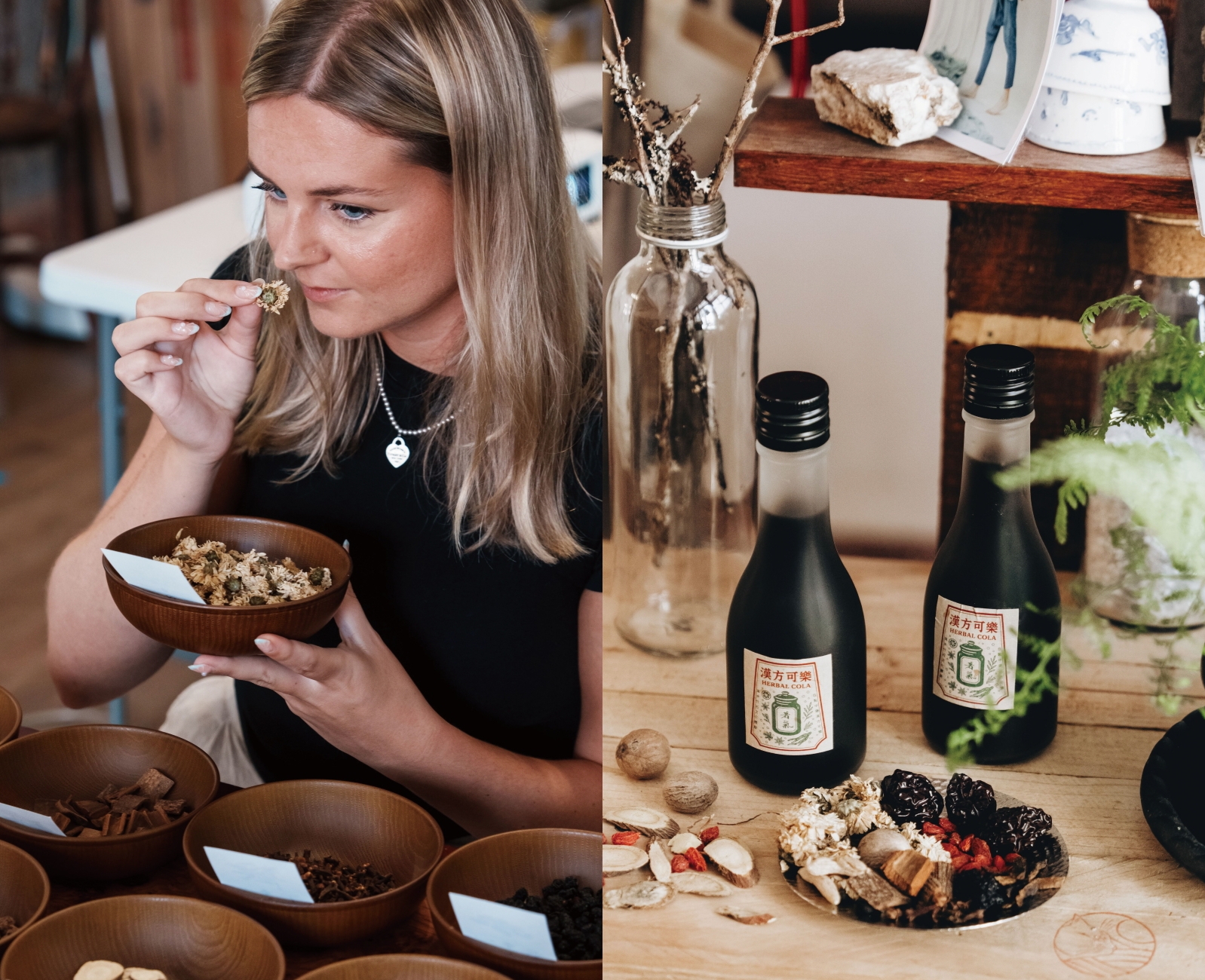
Qiqi gives us an overview of the ingredients we’ll be working with, from sealwort, favored by fasting Daoist ascetics, to the potentially poisonous nutmeg, which can induce hallucinations if improperly consumed. Then we get to the brewing. Qiqi asks us to smell and test each of 17 ingredients before we pick six to eight for our colas, depending on personal taste and medicinal needs.

I select slightly sweeter ingredients such as dried jujubes and mulberries, and those beneficial for women’s health, including ginseng. Meanwhile, my friend chooses a more bitter selection, suitable for someone more accustomed to traditionally used herbal ingredients, which is sweetened with dried chrysanthemum flower.

Next, I measure out each of the ingredients: a piece of cinnamon bark, a handful of jujubes and mulberries, and five grams each of goji berries, cloves, and tangerine peel. Then it’s time to bring the ingredients to a boil in a dash of water, followed by simmering the mix for 25 minutes.

While we wait, Qiqi brings us tastings of two of his special cola recipes, one more sweet with an herbaceous aftertaste, and one more bitter with a hit of classic TCM aromatics. Once our brews have simmered down into a deep amber liquid, we turn off the heat and add in brown sugar to taste, stirring until it turns to that deep mahogany cola color.

Qiqi helps us to strain out the liquid into a jug before we each measure 200ml for our mini take-home glass bottles. We each apply a “herbal cola” label, and voilà, we have a keepsake of our time on Dihua Street (迪化街). Once we get home, we can simply mix one part cola to two parts soda over ice to enjoy our very own brew. Before we leave, Qiqi prepares leftover cola so we can try our creations on the spot. Sweet, floral, and herbaceous, they go down a treat.

This herbal-cola DIY class is especially great for cultural experience activities, team-building sessions, educational trips, and even family outings, with participants receiving an introduction to traditional local industries and practices, and taking home some unique souvenirs.
Caomuzhushi 草木竹石
🔗www.caomuzhushi.com
🔗instagram.com/caomuzhushi.___
🕝Reservations can be made via the LINE app; Upcoming workshops are announced on Instagram