Hiking Neihu’s Sweetest Trails
Text Ami Barnes
Photos Ray Chang
Editor Levarcy Chen
The northern arc of the Taipei Metro’s Brown Line offers numerous options for outdoor adventures, and one spot especially ripe for the picking is the Baishihu area. Up here in Neihu’s hills, you’ll find a fine filigree of footpaths and farms that are tailor-made for the pedigree of hiker who thinks a trail without a coffee stop is no trail at all.

Wetland and Flower Fields
Leave MRT Dahu Park Station via Exit 1 and follow the signs up Dahu Shanzhuang Street towards Dagouxi (Dagou Stream) Ecology and Water-Control Park. In the ten minutes it takes to reach the battalion of owl-like stone sculptures guarding the entrance to the park, you’ll pass a couple of convenience stores where any last-minute provisions can be grabbed. Beyond the strigine statues, two flights of steps lead up to a pavilion atop a low rise, then dip down to meet the stream. (Insider tip: check out the Formosan ash trees flanking these steps; they bear deep scars from the ginormous rhino beetles that emerge here every year around Dragon Boat Festival.)

Built following 2001’s devastating Typhoon Nari, which caused flooding and mudslides in the vicinity, the park is a nifty bit of urban infrastructure that serves triple duty as a flood-control zone, wildlife habitat, and place for locals to relax, exercise, and touch grass. A rocky trail follows the meandering watercourse, and where the stream doglegs around a shelter, a broad pool accessible by steps invites visitors to partake in a little wading. During the warmer months, you’ll find picnic mats crowding the banks, while kids wade through the shallows, buckets and nets in hand. In late winter and early spring, you can also enjoy walking past colorful fields of flowers curated by the city government.

And it’s not just humans that are drawn by the clear, fish-filled waters; the park attracts plenty of feathered visitors too. Egrets and herons are regular sights, along with a small flock of Muscovy ducks that paddle up and down the stream, and on quiet days, keen-eyed walkers might catch the electric-blue flash of a departing kingfisher.

Waterfall With Fireflies
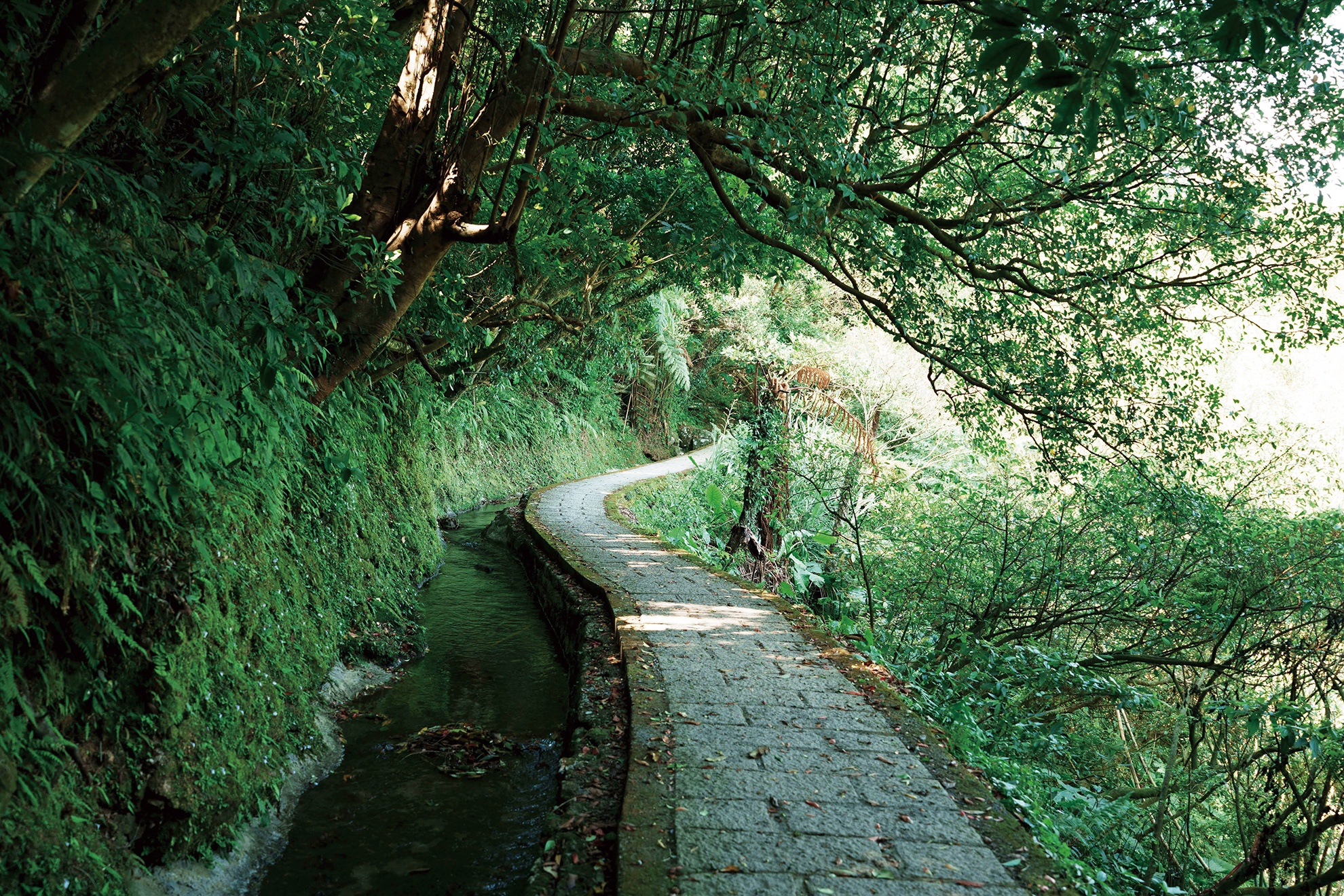
Three bridges carry you out of the park and onto the next section of trail. The third of these is a dainty wooden affair with a roof and a view overlooking a small waterfall. Local retirees (and their dogs) frequent its shaded benches to shelter from the elements and read the papers or listen to portable radios. Beyond the bridges, a steady flow of hikers winds up and down the undulating streamside path. Steep steps on the left divert some of the walkers to the summit of Carp Hill (Mt. Liyu), and then the trail enters its prettiest portion. The trees separating the path from the stream melt away, and you suddenly find yourself strolling through a natural tunnel – leafy canopy above, while to the right, mossy boulders so green as to be almost luminous litter the creek bed.

Keep your eyes peeled along this stretch, and you should spot a simple stone shrine perched on the far bank, which can be accessed by hopping from stone to stone. The temple’s resident deity observes comings and goings along the stream. If you visit at dusk or after nightfall, the warm red glow of votive candles emanates from the small doorway, exuding a quiet sense of protection against the thickening shadows.
In fact, when the air starts to warm up, dusk is a great time to visit this riverside path – that’s when its rich riparian diversity becomes apparent. It’s a veritable herping heaven. Supple-toed tree frogs cling to branches, and toads squat in the middle of the path, recalcitrantly rejecting all attempts to shoo them out of harm’s way. Unsurprisingly, given the all-you-can-catch frog buffet on offer, snakes are also pretty common visitors – you might spot the Taiwan habu, red-banded snakes, greater green snakes, big-eyed rat snakes, bamboo pit vipers, and Taiwan slug snakes just in the short corridor between the wooden bridge and Yuanjue Waterfall, to be visited momentarily. Extra-lucky night hikers may even catch sight of a masked palm civet or hear the indignant alarm call of a giant flying squirrel.

As the sound of Yuanjue Waterfall starts to grow louder, you come to a metal bridge of dubious structural integrity that spans the stream. Don’t cross it just yet, but put a mental pin in your map as you continue onwards. Before long, the path arrives at the base of the waterfall. Circular pavilions have sprouted here like oversized concrete mushrooms, while giant boulders in the middle of the watercourse offer ample opportunities for photos or waterfall watching. A little further away from the water, there’s a grassy patch, which – every April or May – bears witness to the courtship dances of fireflies.
For hikers seeking a straightforward ending to their outing, taking the main trail leading up to the left of the waterfall would see you arrive at Yuanjue Temple (Neihu’s oldest Buddhist center of worship) in roughly ten minutes, and a further ten minutes would bring you to the grand, city-facing structure of Bishan Temple. However, if feeling adventurous, it is time to return to that mental map pin.
The Look of A Dragon
Unlike the earlier well-established paved trail, there’s little – save for a couple of hand-tied hiking tags – to indicate that the path on the far side of the bridge leads anywhere worthwhile. The first couple of hundred meters feel more like a private farming track, but soon you’ll find yourself ascending steeply through dense secondary forest using interwoven roots for footholds and pulling yourself up using fixed ropes.
After 10-15 minutes, the trail arrives at a rocky overlook. You can see high-rises clustered far down below along the Keelung River (into which Dagou Stream flows). The vantage point presents an opportune spot to catch your breath and rally your muscles before tackling the final climb to Dragon Boat Rock.

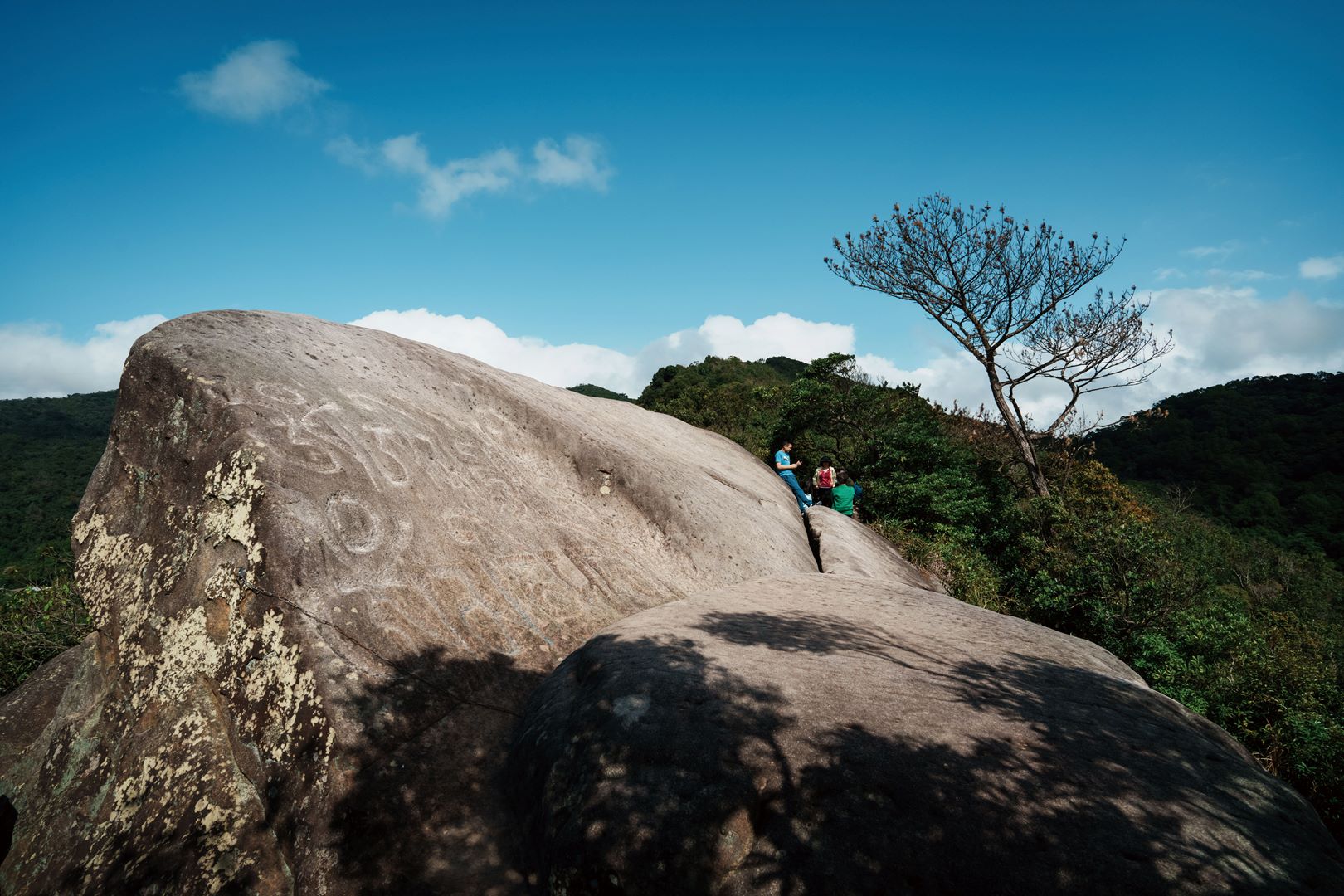
Named for its resemblance to a stone boat, this 10-meter quartz sandstone vessel floats proudly on a choppy ocean of greenery. Its eastern face – port, to use the appropriate boat terminology – slopes down to meet the trees at a forty-five-degree angle. Etched into it are two fissures running the full length that provide much potential for fun photos that make it seem as if you’re dangling precipitously off a ledge. Meanwhile, the boat’s starboard edge is marked by a genuinely perilous sheer drop, so exercise caution when venturing up to admire the views of distant central Taipei.
When you disembark from the stern, follow the stone-surfaced trail to a crossroads. At this point, the easiest and fastest way to return to civilization would be to turn left and follow the path until it joins Bishan Road. There is actually a bus stop right at the trailhead, so you could just wait for the next S2 Shuttle service back to MRT Neihu Station, or you could cool down by following the winding road back through strawberry farms. And for those who have a surfeit of energy (and experience navigating some of Taipei’s wilder trails), there is an opportunity to extend your walk further by heading straight over at the four-way junction and climbing past Mount Kaiyan and onwards to Bishan (Mt. Bi) before curving back to Bishan Road and its welcoming eateries either via Tianshui Yuanyang Lake or Mt. Daluntou.
Strawberry Picking Season
In addition to hiking trails and grand views, this corner of Taipei has a third ace up its sleeve: Baishihu Agricultural Recreation Area. The primary attraction in this elevated agricultural agglomeration is its collection of pick-your-own strawberry farms. From December to May, the area’s greenhouses overflow with rows of ripening red berries growing vertically on easy-pick trellises, and many establishments offer DIY activities, such as making jam or vinegar (pre-booking is strongly advised).

Interspersed among the farms are cafés serving the usual lineup of sweet treats that appear wherever Taiwanese gather for recreation and restaurants of a rustic persuasion, where heartier fare is on the table. Celebrated by holding the Neihu Strawberry Festival, during the strawberry season visitors can also enjoy a stroll across the recently reopened Baishihu Suspension Bridge. The 116-meter pastel-purple span is designed to resemble the rippling of a soaring dragon’s spine, and connects the main cluster of farms with the commanding structure of Bishan Temple.

🔎
Baishihu Agricultural Recreation Area | 白石湖休閒農業區
Baishihu Suspension Bridge | 白石湖吊橋
Bishan (Mt. Bi) | 碧山
Bishan Temple | 碧山巖
Carp Hill (Mt. Liyu) | 鯉魚山
Dagouxi Ecology and Water-Control Park | 大溝溪生態治水園區
Dragon Boat Rock | 龍船岩
Mt. Daluntou | 大崙頭山
Mt. Kaiyan | 開眼山
Neihu Strawberry Festival | 內湖草莓季
Tianshui Yuanyang Lake | 甜水鴛鴦湖
Yuanjue Temple | 圓覺寺
Yuanjue Waterfall | 圓覺瀑布
🗺️Click here to see aforementioned spots on Google Map
This article is reproduced under the permission of TAIPEI. Original content can be found on the website of Taipei Travel Net (www.travel.taipei/en).